
Desert Trips from Agadir: How Far the Sahara Really Is
Atlas Luxury Transfers·3 July 2026
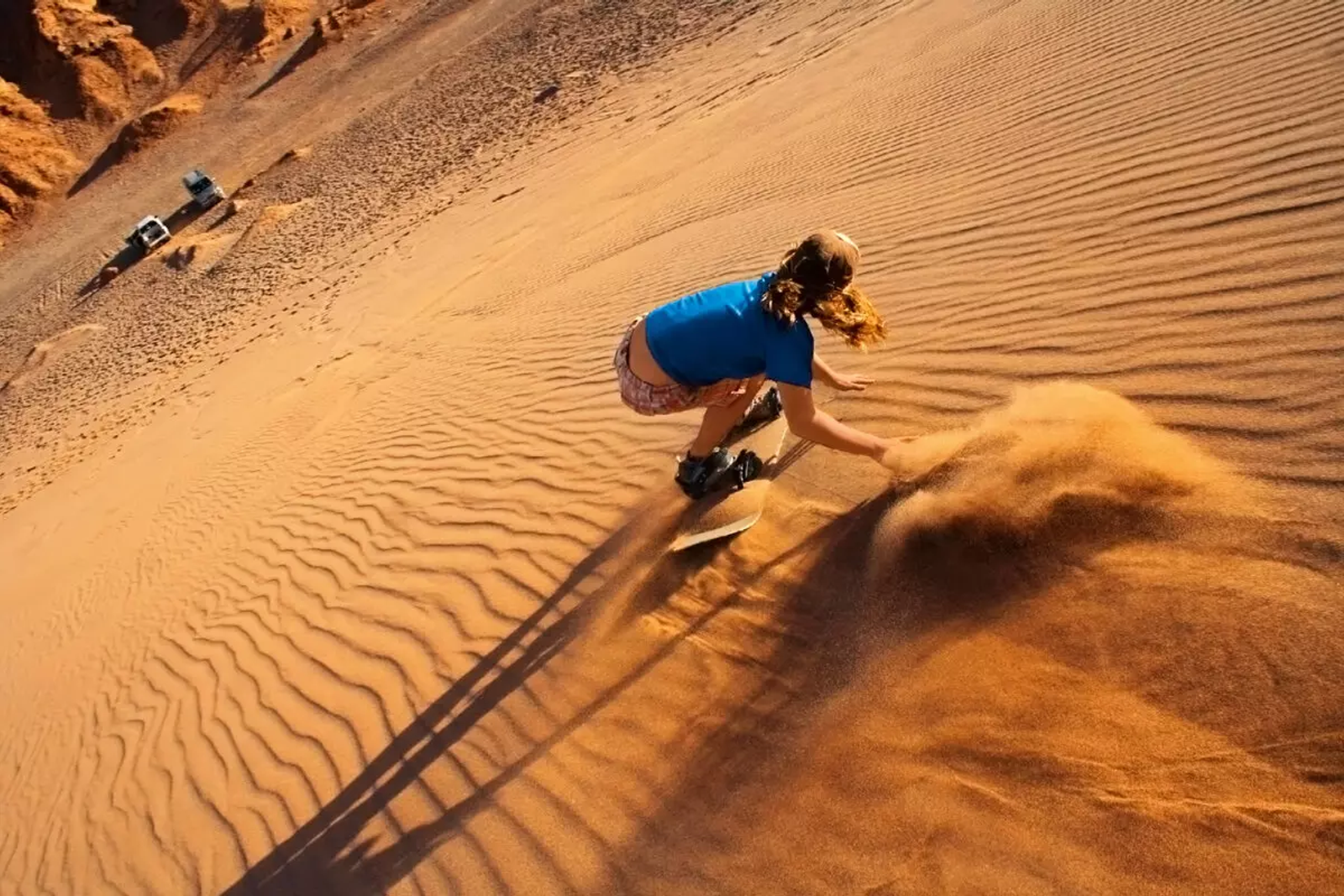
Which dunes a day out of Agadir actually reaches, how the day unfolds, what to put in the bag, why a private 4x4 changes it, and what it takes to stand in Erg Chebbi.
Drive inland from Agadir and the argan trees thin out, the tarmac gives way to piste, and the sand begins. That is the desert a day trip reaches: pre-Saharan dunes, stony plains and Berber villages (not Erg Chebbi, which sits more than ten hours away by road). A day out here means a 4x4, tea poured in someone's front room, a walk up a dune ridge and the sun going down behind it. Half-day and full-day safaris leave all year round. The great ergs are a different trip altogether: several days, and far better with your own driver.
Start with the arithmetic, because it settles the argument. Merzouga, the village at the foot of Erg Chebbi and its sea of orange dunes, is over ten hours of driving from Agadir. Ten out, ten back. Anyone advertising Erg Chebbi as a day trip from Agadir is selling you twenty hours of windscreen and about forty minutes of sand, and we would rather say so here than at six in the morning in a hotel lobby.
What does sit within reach is the pre-Sahara, and it deserves better than being treated as a consolation prize. Head inland and the country changes in stages: argan forest first, then hammada (flat, stony, enormous), then dry riverbeds, then dunes with village life still threaded through them, families who have farmed and herded this ground for generations. You get sand underfoot, a quiet the coast never manages, and people to meet, without losing your holiday to a seat. And if the giant ergs are the whole point of the trip, there is a proper way to do that. It is at the end of this guide.
Pickup is early, because the desert is kinder before ten and after four and the itinerary is built around that. The first hour is still green: argan, goats, roadside stalls. Then the 4x4 leaves the asphalt and the day divides roughly in half between the driving itself, across open plains and dry riverbeds, and the stopping: villages small enough that your arrival is noticed, and the dunes waiting at the far end of it.
What people remember afterwards is rarely the off-roading. It is the tea: three glasses, poured from a height, in a room where somebody actually lives. It is lunch in the shade of a kasbah wall or under canvas. It is taking your shoes off at the bottom of a dune and finding the top harder work than it looked. The dunes come last on purpose: by late afternoon the heat has gone out of the day and the sand turns the colour that every photograph of Morocco is trying to be.
Inland weather does not behave like Agadir weather. The coast is moderated by the Atlantic all year; forty minutes east of it, midday runs hotter, dusk turns colder and the glare is relentless from breakfast onwards. None of that needs a suitcase. A small daypack covers the whole day, and there is always water in the vehicle.
If you take one item from the list below, take the scarf. A metre of light cotton does three jobs out here: it keeps the sun off the back of your neck, it goes across your face when the wind gets up on an exposed ridge, and it is the reason the dune photographs come out looking like the ones you saved before the trip.
A seat on a shared safari is the cheaper line on the invoice and the more expensive one on the day. The morning opens with a circuit of other people's hotels. Every stop then runs to a clock set by the slowest passenger. And the long road sections are spent shoulder to shoulder with strangers. On a two-hour city tour you shrug at all that. Out here it bites, because the things that make the drive worth doing (a sunset nobody is rushing, a tea that turns into a conversation) are exactly what a fixed timetable cannot accommodate.
Going private puts the clock back in your hands. You choose the departure, you stay where the day is good, you drop whatever does not interest you, and you travel with a driver who works in French, English and Arabic and knows which pistes and which villages suit the people actually in his vehicle. Families with small children need that flexibility; so does anyone who wants the sunset without an audience. It is how Atlas Luxury Transfers runs every excursion: one vehicle for your group, one price per vehicle agreed before you set off, and none of the shared-van arithmetic.
There is no closed season. This stretch of coast collects something like 300 sunny days a year and the safaris run through all of them. Given a free choice, take March to May or September to November, when inland temperatures stay warm without turning punishing and the light does the landscape justice.
Come in July or August and the day simply reshapes itself: out early, a long lunch parked in the shade, dunes held back until the afternoon has cooled. Winter is the walker's season (clear, mild, easy underfoot), with one catch, which is how fast the temperature falls inland once the sun is down. Staying for sunset in January means packing the extra layer you will otherwise spend an hour wishing for. The underlying rule never changes with the calendar: the desert gives you its best hours at each end of the day and its worst in the middle.
If nothing but the big dunes will do, give the trip the days it needs: two to four of them, private, with one driver for the whole route. There are two sensible lines east out of Agadir: over the Anti-Atlas by way of Taroudant, or the northern arc through Ouarzazate and down the Draa Valley. Both finish at Merzouga, where you sleep one night or two in a camp pitched out on the sand. That is the version where you ride into Erg Chebbi as the light goes, sleep under a sky with no towns in it, and wake to dunes standing higher than a block of flats.
A journey like that is the entire argument for a private chauffeur: the same driver and the same vehicle from the first morning to the last, luggage handled, the stops chosen by you, and nothing on the road resembling a coach timetable. It prices well above a day trip, and it should, because it is not a stretched day trip. It is a different thing entirely. Our advice, after ten years driving these roads out of Agadir: if you have one spare day, spend it on the full-day safari and take it for what it honestly is. If you want Erg Chebbi, wait until you can give it the nights.
Everything above comes down to three choices, and the deciding factor is almost always how many days you can spare.
Ready to go: Book a private desert safari from Agadir, See every private excursion we run and Book a private driver for a multi-day desert route.
Planning your trip? Book a private transfer or explore our excursions.
Replies on WhatsApp in minutes, 24/7 on reservation. Fixed price per vehicle.
 Replies on WhatsApp in minutes, 24/7 on reservation. Fixed price per vehicle.