
What to Do in Agadir: The City, the Coast and the Day Trips
Atlas Luxury Transfers·22 de junio de 2026
A working guide to Agadir: what fills your days in the city (the beach, the Marina, Souk El Had, the Kasbah hill), what is worth the drive out to Taghazout, Paradise Valley and beyond, and how to move between them in a city where the ride-hailing apps cannot be relied on.
Short answer, for anyone landing this week: Agadir gives you six kilometres of Atlantic sand with a promenade running its full length, the Marina for dinner, Souk El Had for everything else, and the Kasbah (Agadir Oufella) on the hill above town beneath the "God, Country, King" sign. Add the Vallée des Oiseaux and Crocoparc if you are travelling with children. Then look outward: Taghazout and its surf sit about 25 minutes up the coast, Paradise Valley roughly an hour inland, and the Sahara a full day away.
Start with the fact that shapes everything else: the city you walk through today was built after 1960, when an earthquake flattened the one before it. Agadir came back wide, low and open, which is why it feels nothing like the walled medinas of Marrakech or Fès: there are few ancient monuments to queue for. What there is instead, out on the Atlantic coast of the Souss-Massa region under roughly 300 days of sun a year and winters that stay mild, is a very long golden beach, grilled fish straight off the boats, and roads that put mountains, surf and desert within a morning's drive.
That combination makes Agadir a base more than a destination in its own right. Most visitors settle into a rhythm within a day (sand and seafront until the light goes, the Marina after dark) and spend the rest of the week driving out to the surf villages up the coast, the palm-shaded river gorges inland, and the Berber settlements in between.
Enough for several unhurried days. The seafront does most of the work: a broad paved promenade follows the curve of the bay, café after café along it, and it is at its best in the hour before the sun drops into the Atlantic. Follow it far enough and you arrive at the Marina d'Agadir, the smartest corner of town, where the restaurants face a basin full of yachts and nobody is in a hurry to bring you the bill.
For a look at how the city actually lives, two places matter. Souk El Had is among the largest markets in Morocco: a walled grid of stalls where residents do their weekly shop. The Kasbah, Agadir Oufella, stands on the hill directly above town, alongside the enormous Arabic letters reading "God, Country, King." Travelling with children? The Vallée des Oiseaux is a free garden and small menagerie right in the centre, and Crocoparc (crocodiles and landscaped botanical grounds) is a short drive out on the edge of the city.
Go, but go for the panorama, not the ruins. The 1960 earthquake took most of the original fortress with it and nothing has been rebuilt into a museum-grade monument, so expect outlines and walls rather than restored rooms. What the hill hands you is the single best vantage point in Agadir: the whole bay laid out below, the working port on one side, the beach curving away on the other. Late afternoon is when the light makes the climb worthwhile.
The giant Arabic script on the slope beside it ("God, Country, King") reads from most of the city and is lit after dark, which is half the reason it ends up in everyone's photographs. Budget half an hour at the top rather than half a day: it works best as one stop on a wider loop around town.
Two names come up more than any others. Taghazout, twenty-five minutes north along the coast road, is the best-known surf village in Morocco: scruffy in a deliberate way, board racks outside every door, rooftop cafés above them. Its schools will have a beginner standing up the same morning, and its points draw people who have been surfing for decades. Paradise Valley runs the other way, about an hour inland: a gorge in the foothills of the High Atlas where the river gathers into a chain of pools between the palms. Bring shoes you can walk in and something to swim in.
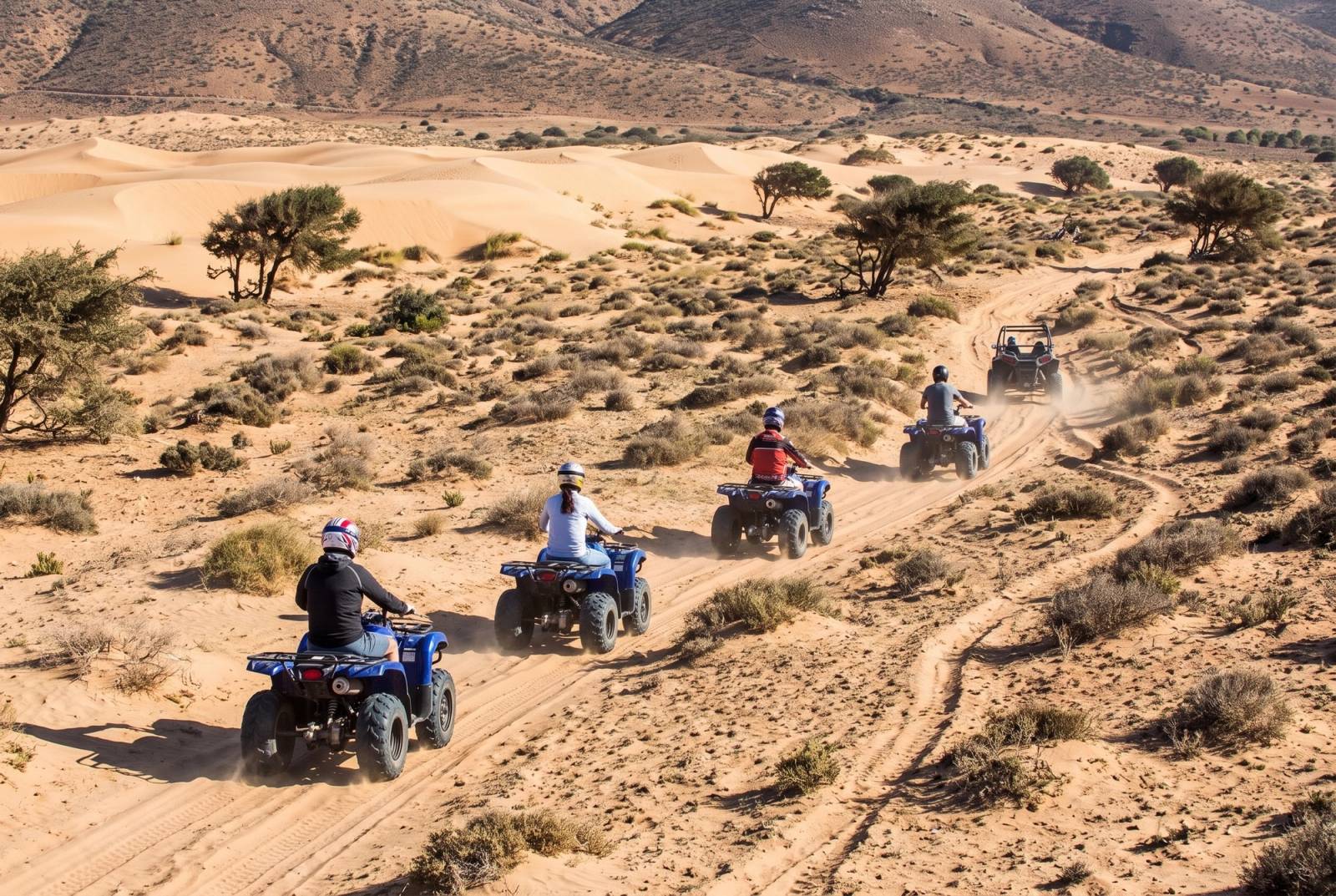
Push further and the full day trips open up: the dunes and Berber villages of the interior, the ochre ramparts of Taroudant (which people call little Marrakech for good reason) and Essaouira, white and windswept on its own stretch of Atlantic. Every one of them is doable and back by evening. Every one of them is also a long day in a vehicle, which is the real argument for a private car and driver over a coach: you stop where you want to stop, you set the departure time, and you are not waiting on forty other passengers at each viewpoint.
Inside the resort strip you barely need a car: the centre, the beach and the Marina all sit within walking distance of each other, and the promenade is meant to be walked. The moment you want the Kasbah hill, Souk El Had, Crocoparc or anywhere beyond the city limits, that changes. Worth knowing before you land: app-based ride-hailing in Agadir is patchy and unreliable, and there is no dependable app pickup at Agadir Al Massira Airport (AGA), which lies about 25 km, call it thirty minutes, from the hotels.
The path of least resistance is a private chauffeur booked in advance at a fixed price per vehicle. The figure is agreed before you travel, so there is no meter to argue over at the end and no booking platform taking its cut in the middle, and the driver speaks French, English and Arabic. He will tell you what you are looking at as you pass it. Atlas Luxury Transfers is a registered Agadir company with ten years on these roads and a phone a human answers; a half-day city tour with us threads the Kasbah viewpoint, Souk El Had and the Marina into one comfortable loop and returns you to your hotel door. You settle in cash with the driver on the day, in euros or dirham.
Everything above in one line each: what it is, and who tends to get the most out of it.
Ready to put it together: see the full excursion list, reserve a private city tour of Agadir or check our fixed per-vehicle transfer prices.
¿Planeando su viaje? Reserve un traslado privado o explore nuestras excursiones.
Respuesta por WhatsApp en minutos, 24/7 bajo reserva. Precio fijo por vehículo.
 Respuesta por WhatsApp en minutos, 24/7 bajo reserva. Precio fijo por vehículo.